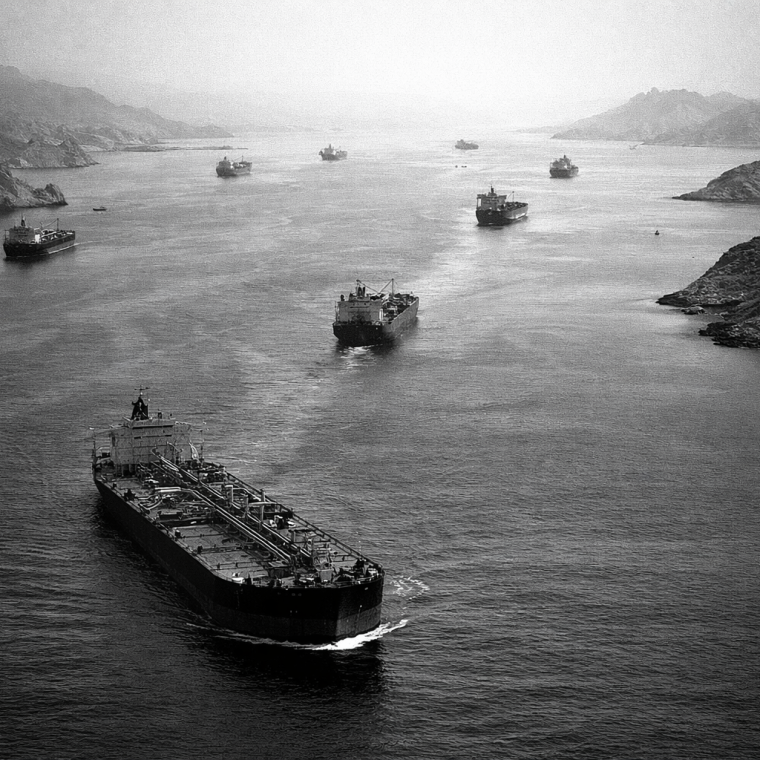


Steel in the Shadow of the Strait: Repricing Risk, Time, and Flow Across the Gulf
In commodity markets, opportunity rarely announces itself. It emerges as distortion—initially at the margins, then progressively across the system. The developments around the Strait of Hormuz are widely interpreted through the lens of energy risk: insurance premiums, naval posturing, and maritime advisories dominate the narrative. Yet this framing captures only the visible layer. Beneath it, a more structurally significant shift is unfolding—one that is quietly reconfiguring how steel moves, settles, and monetizes across the Gulf.

Steel does not move as a singular commodity but as a sequenced system: raw inputs, semi-finished materials, and downstream products, each governed by distinct constraints. When stress is introduced at a chokepoint, the system does not fail uniformly. It redistributes pressure along its chain, amplifying fragility where timing, quality, or financing are least tolerant to disruption.
Value does not emerge from disruption itself, but from how unevenly that disruption propagates.
Friction, Time, and the Repricing of Execution
Under stable conditions, global steel flows operate within narrow arbitrage bands. A Brazil-to-Gulf iron ore shipment follows a roughly 30–40 day cycle, embedded within standardized financing and settlement structures. Margins remain structurally thin, and profitability depends less on directional price moves than on execution efficiency.
Under friction, the system does not simply become more expensive—it becomes non-linear. Cost inflation, such as 15–30% increases in war-risk insurance, is visible and quantifiable. Time distortion is not. Transit ceases to be deterministic and becomes probabilistic, introducing variance that cannot be hedged through conventional financial instruments.
This variance propagates with precision. A delay of several days is not absorbed; it forces a reallocation of production schedules, disrupts feedstock continuity, and alters working capital cycles. The system begins to operate with temporal misalignment—inputs arrive out of phase with processing capacity and demand cycles.
Regional flows within the Gulf basin behave differently. Their defining characteristic is not simply shorter duration, but tighter variance. A 3–7 day cycle is not just faster; it is more predictable, and therefore more bankable. The financial system can price certainty. It discounts volatility.
Execution, in this environment, detaches from price. It becomes an independent variable—implicitly priced through reliability, cycle integrity, and the ability to convert movement into cash within bounded timeframes.
In constrained corridors, price signals degrade. Clearance becomes the operative metric. The cargo that clears predictably is not just safer—it is structurally more valuable.
The Upstream Imbalance: Resource vs. Flow
The Gulf’s upstream imbalance is not a simple mismatch between supply and demand. It is a misalignment between where material exists and where it can move with continuity.
Resource-rich northern zones possess structural advantages in raw material access and energy inputs, enabling competitive DRI production. Yet outward movement is conditioned by friction: constrained financial channels, compliance exposure, and limited routing optionality. These constraints do not suppress output; they inhibit flow.
Southern hubs, by contrast, are optimized for movement rather than extraction. Their infrastructure—logistical, financial, and institutional—is designed to receive, intermediate, and redistribute. Their vulnerability lies in dependence on inbound continuity.
Under stable conditions, long-haul imports synchronize these two ends. Under constraint, synchronization breaks. Material accumulates where it cannot exit efficiently, while demand persists where supply cannot arrive reliably.
The resulting divergence is not fully captured in price. It manifests as a structural spread between theoretical availability and executable supply. Discounting emerges at origin, not because material lacks value, but because it lacks pathways. Premiums emerge at destination, not because of scarcity, but because of uncertainty.
The system does not fragment. It desynchronizes.
Steel-Specific Dynamics: Where the System Bends
The propagation of this desynchronization is uneven across the steel chain.
DRI-based systems, dependent on feedstock consistency, are highly sensitive to upstream variability. Small deviations in input quality or timing compound into measurable efficiency losses. Integrated blast furnace systems, while less flexible, are buffered by scale and vertical integration, making them less immediately reactive to logistical shocks.
Product segmentation further differentiates impact. Long products, tied to regional demand and short-haul billet flows, retain a degree of adaptability. Flat products, reliant on slab imports over extended routes, inherit the full exposure to disruption. As a result, pricing dislocations tend to emerge earlier and more sharply in flat markets.
Scrap dynamics introduce an additional layer. In uncertainty, domestic retention increases as participants preserve optionality. Export flows contract, tightening availability externally. This shifts marginal pressure back onto virgin material supply precisely when upstream channels are least stable.
The system absorbs stress selectively, not uniformly. Its weakest links define its price behavior.
The Compression of Trade Geometry
When long-haul routes destabilize, the geometry of trade compresses.
A long-haul shipment represents a fixed commitment—of time, capital, and route. Once dispatched, its exposure is largely irreversible. Capital remains immobilized for extended periods, subject to evolving risk without recourse.
Short-haul flows operate under a different logic. Their primary advantage is not merely speed, but optionality. Cargoes can be redirected, rescheduled, or reallocated within shorter cycles. Exposure is continuously adjustable rather than statically assumed.
This transforms logistics from a passive cost center into an active control mechanism. Time becomes a lever of capital efficiency. The operator is no longer optimizing cost alone, but the interaction between time, risk, and capital turnover.
The relevant metric is no longer price per ton, but return per cycle.
A Scenario in Motion
A rolling mill operating on long-haul inputs commits to extended cycles with embedded uncertainty. Working capital is deployed ahead of realization, and operational planning is anchored to expected arrivals that may not materialize as scheduled. Variance introduces inefficiency, not only in cost, but in capacity utilization.
A regional sourcing model alters this dynamic. Shorter cycles enable continuous recalibration of inventory and production. Capital is redeployed more frequently, reducing exposure to single-shipment risk. The system shifts from forecast-driven to feedback-driven operation.
Over time, the difference compounds. The advantage is not visible in any single transaction. It emerges in the aggregate efficiency of cycles, where capital, time, and execution align more tightly.
The margin is not extracted from price differential. It is generated through cycle compression.
Execution friction—rerouting, renegotiation, counterparty substitution—is not a deviation from this model. It is intrinsic to it. The system adapts in motion, and value accrues to those capable of operating within that motion.
Arbitrage Beyond Price
In such an environment, arbitrage extends beyond price into multiple interacting dimensions.
Differences in timing, structural positioning, and institutional flexibility create parallel realities within the same market. These realities are not fully reconcilable through benchmarks.
Participants operating across these dimensions are not simply traders of material. They function as connectors between constrained and unconstrained systems.
Friction does not eliminate supply. It concentrates access.
Engineering the Trade
Within this framework, risk is not an external factor to be minimized. It is a variable to be structured.
Logistical exposure can be distributed across shorter, diversified routes. Payment exposure can be layered across multiple channels. Regulatory exposure can be embedded within transaction architecture rather than treated as an external constraint.
Risk, in this context, becomes an allocatable resource—held, transferred, and monetized alongside physical cargo.
Access, Not Scale
As inefficiencies widen, scale becomes less decisive. Access becomes primary.
Access to supply operating below full transparency. Access to demand operating under intermittent constraint. Access to corridors that remain fluid. Access to capital capable of traversing fragmented systems.
These are not static advantages. They are cumulative, built through repeated execution and embedded positioning.
Competition shifts from volume to placement within flow.
The Emergence of Circular Trade
Under sustained friction, the system reconfigures into a circular structure.
Material moves outward from constrained upstream environments into intermediary hubs where it is transformed—logistically, financially, or contractually—before being redirected toward demand centers. These flows are not linear. They loop, adapting continuously to shifting constraints.
Resilience emerges not from stability, but from the capacity to re-route within a closed system.
The Window
These conditions are transient. As friction normalizes, pathways reopen, and pricing converges.
Yet during the period of misalignment, a window exists. It is defined by the divergence between physical availability and executable movement.
Those who recognize this divergence early do not merely respond to volatility. They position within the system’s reconfiguration.
Closing Observation
The current phase in the Gulf steel trade is not defined by disruption, but by structural adjustment.
Value is shifting—from static measures of cost toward dynamic measures of time, access, and execution.
The most meaningful signals are not visible in price. They are embedded in flow.
For those positioned within that flow, the market is not unstable.
It is repricing.
If you find this kind of analysis useful—focused on how markets actually function under constraint, not just how they are priced—I share similar insights regularly. You can follow me here on LinkedIn for more perspectives on commodities, trade flows, and cross-border market dynamics.