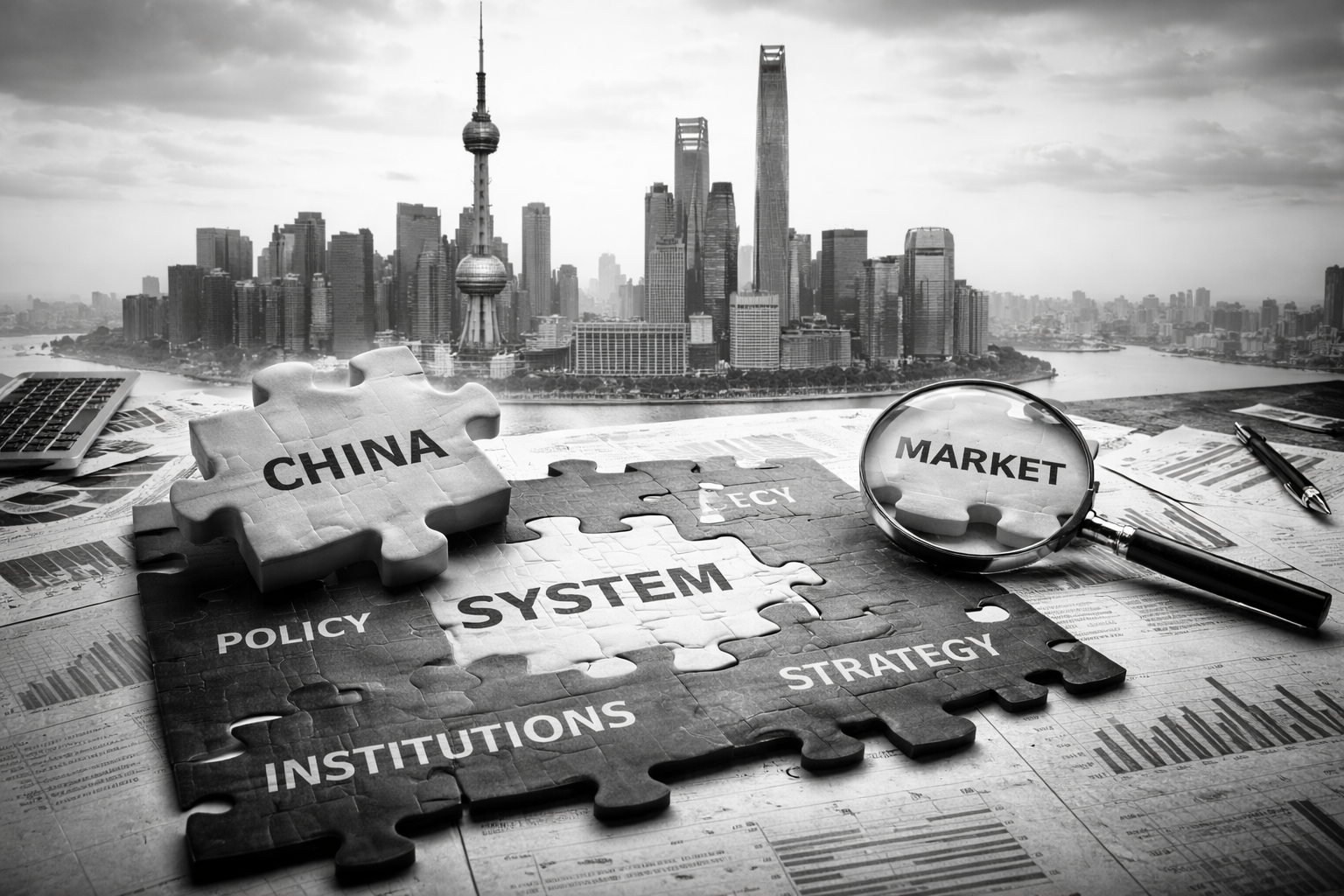


China investment risk is often misunderstood, and most investors focus on the wrong factors.
When investors talk about China, the conversation almost always turns to risk. Regulation, policy shifts, geopolitical tension, transparency—these are the concerns that dominate boardroom discussions and investment committees. They are not unfounded. China is a complex environment, and risk is real. But the way risk is commonly understood is often incomplete, and in many cases, deeply misleading. Because the greatest risk in China is not regulation itself. It is the misinterpretation of the system that produces it.
For many foreign investors, regulation is perceived as the primary source of uncertainty. It is seen as unpredictable, interventionist, and at times opaque. This perception leads to a defensive posture—caution in capital allocation, hesitation in market entry, and a tendency to overemphasize compliance as the central challenge. While regulatory awareness is necessary, this framing misses a more fundamental point. Regulation in China is not random. It is not an isolated force acting independently of the broader environment. It is an expression of a system—one that reflects policy direction, strategic priorities, and institutional coordination.
This distinction matters because it changes how risk should be evaluated. If regulation is seen as arbitrary, then risk appears uncontrollable. But if regulation is understood as part of a structured system, then it becomes interpretable—imperfectly, but meaningfully. The problem is that many investors stop at the surface. They react to regulatory outcomes without understanding the underlying logic that drives them. They see the effect, but not the cause. And in doing so, they position themselves in a reactive mode, rather than a strategic one.
This is where misinterpretation becomes more dangerous than regulation itself. An investor who fears regulation may hesitate, delay, or reduce exposure. But an investor who misunderstands the system may move forward with confidence—into the wrong sector, with the wrong assumptions, and at the wrong time. The consequences are more subtle, but often more severe. Instead of a clear external shock, they experience slow underperformance, strategic friction, and a gradual erosion of the investment thesis. The business does not collapse. It simply never reaches its expected potential.
Much of this misreading comes from applying familiar frameworks to an unfamiliar structure. In many markets, regulation serves as a boundary condition. It defines what is allowed and what is not, but within those limits, market forces largely determine outcomes. Investors can model scenarios, price risk, and optimize decisions with a reasonable degree of confidence. In China, regulation is more deeply integrated into the evolution of the market itself. It does not only restrict; it also guides, accelerates, and reshapes. Entire sectors can expand rapidly under policy support and then adjust direction as priorities evolve. To an external observer, this can appear inconsistent. In reality, it often reflects continuity at a deeper level.
Understanding that continuity requires a shift in perspective. Instead of asking how regulation might change, the more relevant question becomes why it changes. What objectives is it serving? What direction is it reinforcing? What trade-offs is it managing? These questions move the analysis from reaction to interpretation. They do not eliminate uncertainty, but they reduce the likelihood of being surprised by outcomes that were structurally predictable.
Another layer of risk that is often overlooked is the gap between formal rules and practical execution. Investors may study regulations carefully, consult legal experts, and ensure compliance on paper, yet still encounter challenges in implementation. This is not necessarily a failure of law, but a reflection of how the system operates across different levels. National policy, provincial priorities, and local execution can interact in ways that are not always perfectly aligned. Reading China requires attention not only to what is written, but to how it is applied. This is where many foreign investors, despite thorough preparation, find themselves navigating ambiguity.
The consequence of misreading these dynamics is rarely immediate failure. Instead, it manifests as misalignment. A company enters a sector that appears open, but lacks long-term support. A business model is approved, but does not scale as expected. A partnership is formed, but operates under different assumptions about incentives and direction. Each decision, taken in isolation, may seem reasonable. Together, they create a structure that is fragile under changing conditions. By the time the misalignment becomes visible, the cost of adjustment is high.
This is why the real risk in China is not simply what can be seen, but what is misunderstood. Visible risks—regulation, competition, macro shifts—can be monitored and managed. Structural risks—misinterpretation, misalignment, misplaced assumptions—are harder to detect because they originate in the analytical framework itself. They are embedded in how decisions are made, not just in what decisions are made. And because they often produce delayed consequences, they are frequently underestimated.
For investors who take China seriously, this creates a different kind of requirement. It is not enough to assess risk; one must learn to read it. This involves developing sensitivity to signals that are not always explicit, integrating multiple layers of analysis, and maintaining a degree of humility in interpretation. It means recognizing that clarity in China is rarely absolute, but can be progressively improved. And it means accepting that being approximately right about the system is often more valuable than being precisely wrong about the market.
None of this eliminates risk. China remains a complex and evolving environment. But complexity does not imply chaos. Beneath the apparent uncertainty, there is structure—one that connects policy, institutions, and market behavior into a coherent, if sometimes difficult-to-read, whole. Investors who learn to engage with that structure do not avoid risk entirely, but they engage with it more intelligently. They move from reacting to events toward understanding patterns.
The challenge, of course, is that reading this system is not intuitive, especially for those trained in purely market-driven environments. It requires a different framework—one that connects policy, institutional behavior, and market dynamics into a single analytical lens. In my upcoming book, I break down this framework in a practical and structured way, showing how investors can move beyond surface-level risk assessment and begin to understand what actually drives outcomes in China. For those navigating real capital decisions, this is where risk becomes not just something to avoid, but something to interpret.